Rabu, 25 Januari 2012

Alexei Jawlensky

Alexei Jawlensky Self-Portrait
Sometimes I am amazed at the abysmal lack of depth when it comes to recognizing American artists from the past. Asked to name some American artists, most people don't get far past Rockwell, Wyeth, Gilbert Stuart, Grandma Moses, maybe Jackson Pollock, oh, and Thomas Kinkade. Now there's a mixture. Not much depth but breadth as wide as the whole continent. Actually, I think maybe we Americans are more familiar with artists of world renown than those from our own shores. From that list we might rattle off Picasso, Michelangelo, Leonardo, Raphael, Rubens, Rembrandt, Turner, Van Gogh, Monet--the list is longer but still not much depth. Okay, how about Russian artists? Blank stares. Marc Chagall? Okay, if you say so...

Schokko with Red Hat, 1909,
Alexei Jawlensky

Well, if you'd like a similar list of breadth rather than depth, you might add to Chagall, Kandinsky, Gorky, Malevich, and Jawlensky (above). This is about the one you never heard of, the last one, Alexei Jawlensky (pronounced yaw-LEN-skee, not nearly as hard to say as it looks). He was from roughly the same time period as the others. He was born in 1864, died in 1941, and it's a fair bet they all knew one another. Jawlensky was the son of a Russian army officer. He first exhibited an interest in art in 1880 when he visited an international art exhibition in Moscow and saw for the first time the work of the French Impressionists. He was sixteen.  Kandinsky and others recall seeing the same show and the profound effect it had upon them. This breath of French fresh air (and color) really shook up Russian art. 
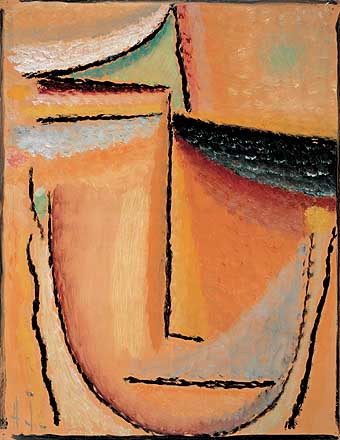
Abstract Head, 1928, Alexei Jawlensky
At the age of twenty-five, Jawlensky began studying at the St. Petersburg Academy under the realist painter, Ilja Rjepin (now there's a name you can forget about pronouncing). One of Rjepin's students was the wealthy Marianne von Werefkin (below, left) whom Jawlensky fell in love with. Rather than Realism though, his painting style veered toward French Symbolism and German Romanticism. In 1896 Jawlensky and Werefkin, along with her housemaid, Helene Nesnakomoff, moved to a suburb of Munich where Jawlensky flirted with German Expressionism, French Fauvism, and behind Werefkin's back, her housemaid, Helene. And while Werefkin gave up her own considerable painting career to promote Jawlensky's, he repaid her dedication by fathering a son, with Helene. And though this Menage-a-trois must have been a strain after the birth of Andreas, the four of them continued living together for another nineteen years before he finally married the boy's mother.

Marianne von Werefkin, Self-portrait, 1910
Portrait of Lisa Kummel,
1929, Alexi Jawlensky
Jawlensky was associated with any number of Expressionist movements of the time, including Der Blaue Reiter, and the Berlin Secession, but he never actually joined any of them, preferring, some might say, to be a movement unto himself. He must have had quite a way with women, for by 1916, even before marrying Helene, another mistress, Emmy Scheyer, also gave up a career in art to support his. In fact, by 1927, he had a whole association of female artists who formed a foundation called "The Association of Friends of the Art of Alexei von Jawlensky" led by Lisa Kummel (above, right) and the painter/art patroness, Hanna Becker von Rath. Despite his obvious popularity with a harem painters of the opposite sex, it didn't keep the Nazi's from banning the display of his increasingly abstract work in 1933, nor from including three of his paintings in the infamous traveling exhibition of "Degenerate Art" which they organized. Eventually seventy-two of his paintings were confiscated and destroyed by the German government before the war.

Selasa, 24 Januari 2012

Alex Katz

Alex Katz
In the latter half of the twentieth century, since the advent of Abstract Expressionism, the tendency in the art world and among the general public has been to divide all artists into two camps--Realists and Abstractionists. Even people who ought to know better fall back on this dichotomy of oversimplification. And the art world especially hates those artists who straddle the fence, sometimes painting realistically, sometimes painting abstractly, as if they were somehow schizophrenic in doing so. Some artists even manage to "straddle the fence" in the same painting. Of course the labeling critics will look at the work and cast it one direction or the other, either Realism or Abstraction, based sometimes, I think, on pure whim. One of the artists whom they love to do this to is Alex Katz.

                                                         Varick, 1988, Alex Katz
Katz was born in 1927, in Brooklyn, later moving to Queens--New York born and bred--still lives there, in fact. His parents were Russian-Polish immigrants, steeped in the arts. He studied at the legendary Cooper Union, practically in his backyard, coming of age in the art world almost precisely at the dawn of the Abstract Expressionist era. By all rights he should have become an abstractionist. He was a contemporary of Pollock, Rothko, Hoffman, Johns, Motherwell, and all the others, but amazingly, any abstract tendencies in his work are strictly formalistic. Perhaps it was because he won a scholarship to study at the Skowhegan (Maine) School of Painting and Sculpture, taking him away from the boiling pot of the New York School right when it was bubbling at its hottest. Not surprisingly, given the environment, he picked up a love of landscape painting, very nearly the antithesis of Abstract Expressionism at the time. 

Ada and Alex, 1980, Alex Katz
Katz's first one-man show was in 1954 at the Roko Gallery in New York. The headlines might have read: "Hometown boy returns and makes good."  Except it wasn't at all like that. His landscapes and poster-like, flattened portraits were quite out of step with the mainstream. It took the passing of the Abstract era and the 1950s before the advent of figural painting and Pop allowed Katz's work hit its stride. It fell neatly into both categories, even though it displayed a number of quite abstract elements.  In the 70's and 80's, he capitalized on this blending. His Varick (above) from 1988 is a prime example, or his Ada and Alex from 1980 (left, a double portrait of himself and his wife). Both are excellent examples of his mature work. In the portrait, an exquisite, design realism dominates. In Varick the five by twelve-foot black canvas seems the ultimate minimal statement, until one begins to inspect the bank of twelve small rectangles in the upper left corner--lighted windows of what appears to be a second story office or lab. Suddenly, the mind flip-flops, making a futile effort to discern the rest of the structure amid the impossibly inky night.

Piers 6, 1998, Alex Katz
The poster-like quality of many of Katz's paintings has led him into the printing field, creating, in collaboration with master print makers, same-size screen prints of his favorite works, all intended to dominate walls just as his enormous paintings do. Unlike many painters who find themselves at the mercy of publishing houses, Katz takes an active, hands-on role in the printing of his works, usually is editions of less than fifty. He has even found occasions when he likes the print better than the original painting. And recently, just to confound the damnable critics, he sometimes goes so far as to veer off into purely abstractionist images such as his Piers 6 from 1998.  Excuse me for playing favorites, but I love an artists who can (and will) do that.  In my own work, I consider the most successful, those paintings that straddle the proverbial fence--Realism which, in its sometimes highly abstract qualities, appeals to those who can appreciate such things, and in its illusional, subjective content, those who can't.

Senin, 23 Januari 2012

Aelbert Cuyp

One of many Chicago Cows having escaped
the slaughter house.
Artists in the city of Chicago a few years ago discovered the cow. Actually, rediscovered might be a better term. With the city's history as the meatpacking center of the Midwest, it's a natural affiliation. Their sculptural versions were the talk of the town. Even some of my friends were involved in this project. Although I've never sculpted one, I've painted a few over the years. I, myself, prefer close-up portraits. There seems to be a certain earnest quality (for lack of a better term) in those warm, almost loving faces. I suppose they'll never make household pets, but I'm sure quite a number of 4-H members have fallen in love with their barnyard pet projects in the past. And where would we be without cows. The milkshake and hamburger, not to mention dozens of fast food chains would not exist without them. In the mid-1600s, a Dutch artists seems to have had a love affair with those of the bovine set; and I dare say no one ever painted more of them or painted them better than an artist by the name of  Aelbert Cuyp (pronounced KIPE.)

River Landscape with Cattle, 1645-50, Aelbert Cuyp
Cuyp never started out to paint cows. He did come from a long line of Dutch painters in and around Dordrecht, Holland, though. His grandfather was a glass painter. His father, Jacob Gerritsz Cuyp, was a portrait painter, especially talented with children, though his landscapes seemed to have been highly prized as well. He taught his son to paint, often allowing the boy to fill in landscape backgrounds as part of his portraits. In addition, Aelbert's uncle (his father's half-brother), Benjamin Gerritsz Cuyp, was quite adept at biblical and genre scenes imitating Rembrandt's use of light and shadow. But Aelbert himself took after several Utrecht painters, including Salomon van Ruisdael, Jan Both, van Goyen, and Saftleven. Jan Both in particular studied in Italy and brought back to Holland the influence of Claude Lorrain. And as much as he might have been the chief public relations force behind the Dutch dairy industry, Cuyp was just as interested in the watery landscapes and clouded, morning or evening light which illuminated them as he was his barnyard friends. He instilled much of the romantic quality of Lorrain's Italian landscapes into their Dutch counterparts, then added cows.
Herdsmen Tending Cattle, 1655-60, Aelbert Cuyp
The cows are always quite dignified, often more so than their human tenders, who often seem to be mere decorations or afterthoughts in his compositions. They are fascinating foregrounds for Cuyp's deep, luminous, airy studies of light, weather, water, and dimly perceived Dutch towns on distant horizons. Some have called Cuyp the rural counterpart to Jan Vermeer. For a man who never traveled more than a hundred miles from his birthplace, there is a very cosmopolitan quality to his painting style that made his work highly prized, not in the Netherlands, but in England where he was an influence upon English painters such as John Constable and J. M. W. Turner.

Portrait of a Girl with Peaches, 1650-60,
Aelbert Cuyp
After the death of his father and brother, Cuyp's work took on a grander scale and began to include portraits as well as landscapes. But in 1659, in a strange twist not unlike what often happened with female artists, he married Cornelia Bosman, a wealthy widow, and from that time on, lacking the financial need to paint, appears to have devoted himself exclusively to the work of the Dutch Reform church. He had a small group of followers who continued his style after his death in 1691, but unfortunately, none of them ever painted any more cows.

Quite apart from cows, when in a "fowl" mood,
Cuyp was not above painting
A Rooster and Chickens, 1651

Minggu, 22 Januari 2012

Adolphe-William Bouguereau


Charity, 1878,
Adolphe-William Bouguereau
All of us who have learned to become fans of the Impressionists delight in reading about their heroic underdog status in French art; and their slow but persistent rise to acceptance during the late-19th century. We take special pride in their eventual triumph over their enemies in the French Academy des Beaux-arts; and point contemptuously at the neoclassical potboilers their work came up against (and usually lost to) at the art cattle-calls known as the Salon. However, I think to appreciate Impressionism we have to also come to some appreciation of Academicism too. To simply say it was 180-degrees opposite is to give it very short shrift. It was, of course, much more than that. We're familiar with the big names, Poussin, Ingres, Cabanel, and a couple more, but one artist of their ilk which we know little about is Adolphe-William Bouguereau. This is not surprising. In the work of Poussin, Ingres, even Cabanel, we can find something to admire, maybe even love. Bouguereau and his work so perfectly fits the mold all the Impressionist (and thus their admirers) came to hate that he's been relegated to obscurity as a sort of malicious, artistic retribution for past wrongs.

Return of Spring, 1886,
 Adolphe-William Bouguereau,
cupids sprinkled like salt.
As I often do, once I "discover" a somewhat obscure artist somewhere, I go to the Web, often only to find, to my dismay, that he or she was even more obscure than I thought. Not so with Bouguereau. I was not prepared for the sheer quantity of his images nor the apparent devotion of his webmaster friends. The man painted something on the order of 700 major works. Frankly, I tackled Bouguereau prepared not to like him. And, indeed, there is a lot not to like. He can be sickeningly sweet, sexist, pretentious, sentimental, and slick. His 1878 painting, Charity (above, left) epitomizes the worst of all these traits. On the other hand, long after I had basically "absorbed" Bouguereau, I found I could not stop looking at his work. He's amazingly fascinating. The man had a deep respect for the nude figure but seldom succumbed to what we might term "gratuitous" nudity, except perhaps in his cupids which often seemed sprinkled like salt over his canvases. His work often displays the sort of sanitized eroticism the Academy was famous for, but like the dominant male audience for whom he painted, I found myself looking at these first. Did I like them all? No, but they led me deeper into his work. And unlike some of his counterparts, the depth was there to plumb.

The Bohemian, 1890,
Adolphe-William Bouguereau,
one of his more admirable pieces.
Bouguereau was born in 1825, spent seven years studying at the Ecole, and graduated winning the Prix de Rome in 1850--three more years studying in Rome. The man new his stuff. Technically, during the last half of the nineteenth century, he may have been the best of his kind in French art. He was certainly the most popular. His portraits, what few there are (left), bear the mark of Ingres but given his time and place, that's to be expected. His classical subjects are heavily weighted with female figures but that too is not surprising. Perhaps weakest, are his religious subjects. The best that could be said of them is that they make for a rich repository of Sunday School images. Unlike Cabanel who actively, even belligerently, battled the upstart Impressionists, Bouguereau seems not to have understood them and was more given to ignoring them. But in the end, he could not. With the ascendancy of Impressionism, especially in the 20th century, his work quickly fell out of favor, prices plummeted, and as a result, in the U.S., just about any museum worthy of the name could afford one. As a result, they're everywhere, they're everywhere! And now, during the past 25 years, they are again appreciated by collectors, not as juxtaposed against Impressionism, but as fascinating art reflecting its era--no better, no worse.

The Flagellation, 1880, Adolphe-William Bouguereau,
a bloodless, Sunday School depiction.

Sabtu, 21 Januari 2012

Wolf Kahn

Self-Portrait, 1954, Wolf Kahn
Although it's not so critical in art, one of the problems of studying computer sciences is that the education you get has a shelf-life of...ohh...say...fifteen minutes? No, it's not quite that bad, but things change so fast that in as little as fifteen months, unless the individual keeps up on things, he or she becomes a technological Neanderthal. Other practitioners from doctors and to auto mechanics have the same problem except not on quite such an accelerated timeline. For artists, the situation is a somewhat less critical, though not without it's similarities. Tools change; so do materials, techniques, styles, tastes, and marketing practices. Fifteen years ago, computers, for instance, were an anathema to most artists, the very antithesis of what it meant to employ the human touch to the creative act. Today, many artists would sooner give up their brushes than part with their beloved bucket of bugs.

Green Tangle Pastel, 2004,
Wolf Kahn, styles change, so
do artists.
Imagine the plight of an artist during the 1950s, studying in Europe, soaking up the great Abstract Expressionist theories and techniques, immersing himself in color, Italian Futurism, and the centuries of artistic beauty associated with the city of Venice. Now multiply that times two as that artist marries another artist. When they return to New York about 1960, they discover, to their dismay, that their cutting edge Abstract Expressionism is suddenly so dated that critics wouldn't even look at it, much less write about it. It would be enough to make one start to think about painting canned goods or fast food. That was the plight of Wolf Kahn and his wife, Emily as they faced the desperate realization that Pop was popular and their giant, abstracted, color, nature studies were dead in the water.

Mineral Spirits, 1993, Emily Mason Kahn
However, as any truly dedicated artists would, they persisted. Working well outside the mainstream, Wolf's work became more about nature, less abstract perhaps, but nonetheless eternally about color harmonies, and disharmonies. Eventually, some degree of success came along, gradually outstripping that of his brother, Peter, who was also a noted painter, but whose interests were more broadly focused on several other of the arts. Wolf's nature paintings were not landscapes in the traditional sense. They were not so much depictions of nature, but more accurately distillations. Emily's work remained quite abstract and gestural, her colors slipping and sliding across the canvas like oil on water, glistening and glowing ephemerally. Emily's creative efforts also include work that previous generations of female artists seldom experienced--raising a family. She notes that in the past, "...women painters did not have children, or if they did, they were not taken seriously." Emily and Wolf have two daughters. Cecily is a painter (the most avant-garde in the whole family) while Melany is a filmmaker. In that Wolf's mother was also a painter, the girls make up three generations of creative efforts in the arts.

The work of Cecily Kahn can be seen at: www.cecilykahn.com

Jumat, 20 Januari 2012

Why Sculptors Envy Painters

How sculptors must envy painters! As painters, we pull together our works through many different processes. But the two most critical points are the beginning and the end. It could be a photo, a drawing from life, a scene painted on location, or just simple "inspiration" but we all have our sources. And just as important as the process in getting ready to paint is that leading up to the last stroke, when we are in the process of exhausting our last drops of genius and making the ultimate decision regarding the work--it's finished. In between, from preparing the canvas to drawing, and through the whole painting process, there is room for lots of trial and error, and seldom is there much of a possibility for a single mistaken stroke bringing the whole thing crashing down around our ears. It's little wonder then that an artist such as Michelangelo, the sculptor, would consider mere painting such a trivial pursuit and find the need to work on paintings of such enormous scale in order to challenge his genius.

David (preliminary drawing),
1501, Michelangelo
As a sculptor, Michelangelo began planning his work much as he would if he were painting it. He started with drawings, often several, depicting various parts of the work, evolving it into the completed design. As the idea grew in his mind, so too did the scale of his drawing until it was the actual size of the final sculpture. (Michelangelo planned most of his works from a single viewpoint.) As he made the arduous journey into the Apuan Alps to Carrara to select his stone, he must have envied the ease at which a wooden panel or bare wall could be plastered, ready to paint. He would spend days and weeks choosing the stones for a large commission, looking for faults, discoloration, and other defects. Then the stones had to be carefully cut free and moved down the mountain on skids, managed by huge ropes and lots of human muscle, whereupon each was loaded onto a sturdy wagon to be pulled by a train of up to ten teams of stout oxen, each team with a driver mounted on their yoke to "encourage" the animals to move the great weight. And if the ground was wet, forget it! Fortunately, Michelangelo didn't have to go through all that for his David. He "inherited" the David block from the Florentine city fathers, who commissioned the work. The chunk of marble was a misbegotten leftover from an earlier sculptor's incomplete effort. However, moving the finished piece to its original setting in the Piazza della Signoria, must have been a nerve wracking endeavor for all concerned.


David, 1504., Michelangelo
The  uncarved marble had lain derelict in a weed-choked field near Florence's Duomo for  several years. The trip to Michelangelo's workshop amounted to only a few city blocks. Quite massive and heavy, yet fragile, any mishap could result in it being broken and made largely worthless. Once in place, ready to be carved, Michelangelo transferred a full-size drawing to the front of the stone, then began work, hacking away at it. Unlike many sculptors before and since, studies of his unfinished pieces tend to indicate Michelangelo liked to work primarily from the "front" of his work toward the back. It's believed he may have used a visual aid in working on the sculpture--a wax model, lying on its back, submerged in a container of water scaled to the outside dimensions of the stone. As water was dipped from the container, it exposed the front of the model allowing him to see that part of the stone which should be cut away to "free" the figure trapped within. Michelangelo was one of the fastest "marble cutters" of his time, yet, even with this little "trick," a smartly trained eye, years of experience, and a workaholic lifestyle, it took him three years to carve his David. Now, aren't you glad you're a painter?

Kamis, 19 Januari 2012

Wayne Thiebaud

Thiebaud cartooning during his army days, 1944
One of the great things about studying Pop Art is that many of its painters are still alive. Whether you're talking Lichtenstein (no longer living) or Indiana or Claes Oldenburg (yes, he painted too), they have all taken their five years of Pop Art fame, built on it, and moved on. One of the more interesting of these, and perhaps more under-appreciated than most, is Wayne Thiebaud. It's hard to say why, but just maybe it's because, while the others were are New York artists, Thiebaud is west coast born and bred. Actually he was born in Mesa, Arizona, in 1920, but close enough. And though he flirted with the New York art scene for a time in the 1950s, everything about him and his art almost literally screams California! This former art teacher, former Disney animator, former Universal Studios illustrator, and former Rexall Drug chain artist is more Californian than prunes or palm trees.


Wayne Thiebaud with his favorite food and
favorite art, Marthacakes, 1963, one of the
tempting confections (though inedible)
which made him famous.
Just looking at Thiebaud's 60's Pop creations will make you gain ten pounds. His work is like Edward Hopper gone mad in a deli bakery. Indeed, Thiebaud claims a great deal of affinity with Hopper. His paint, his style, his cold, dismal calculation, yet hot color environment is Thiebaud's most noticeable influence. But there is also the spirit of Chardin inhabiting his luscious cupcakes and bundt confections. There is David Park, Richard Diebenkorn, the rich, expressionistic colors of Rockwell Kent, and even Balthus haunting his work as well. Thiebaud considers himself a cartoonist who learned to paint. Indeed, in his early years, he lived in a YMCA where he drew cartoons six days a week then took off every Wednesday to make the rounds of New York magazines hawking his work.  Even now he considers his work caricature--not in the usual sense of drawing recognizable faces of celebrities, but caricatures of things. And still today, just as with his Pop Art, he's especially fond of food. Yeah, ain't we all.

River Cloud, 2002, Wayne Thiebaud
Thiebaud was raised a Mormon, on a farm that raised food. He milked cows, rode horses, fed the chickens, plowed the fields, planted the corn, potatoes, and beans; and in his "spare time" played with art--little projects his mother made up for him. He was sixteen before he began to seriously study art, but it was his work in restaurants as a teenager that may have had more to do with his art than what he learned in school; especially since he had no formal art instruction after high school. He learned on the job, drawing John Wayne, Marlene Dietrich, and presumably Mickey Mouse. Today, mixed among the hot dogs and hors d'oeuvres, are cockeyed views of the city, often seen from above, where thoroughfares tangle like spaghetti, incline like roller coasters, and swirl downward like children's slides. At first glance, they seem nonrepresentational, except perhaps to Californians, use to peering down through TV lenses from helicopters watching traffic or high-speed freeway chases. Still dapper, even preppy, at 91 years of age, Thiebaud enjoys tennis as much as painting, and still the art teacher, he likes talking about art, more than either one.